
Case Study: How Google Changed the Rules of Marketing (Again)
Every generation of marketers eventually learns the same lesson:
The strategy that made you successful won't work forever.
Newspapers learned it when the internet arrived. Retailers learned it when Amazon changed how people shopped. Taxi companies learned it when smartphones made hailing a ride as simple as tapping a button.
Marketing has its moments too. Google changed everything. Social media changed it again. The smartphone rewired customer expectations. Marketing automation transformed how businesses followed up.
Today, we're living through another one.
And one of the clearest case studies isn't a contractor.
It's HubSpot.
What Happened to HubSpot
For most of the last fifteen years, HubSpot was the gold standard of content marketing. They didn't just write blog posts. They built an entire growth engine around the idea that helpful content earns trust, trust earns clicks, and clicks turn into customers. It worked so well that "inbound marketing" basically became a category HubSpot invented and then dominated.
Then, starting in late 2024, something broke. HubSpot's organic traffic didn't dip. It fell off a cliff, dropping somewhere in the range of 70 to 80 percent in less than a year. This wasn't a small SEO player. This was one of the most sophisticated, well-resourced content operations in the world. Their own CEO said it plainly on an earnings call: search traffic is declining globally, because AI tools are answering the question before anyone clicks through to a website.
Here's the important part. HubSpot didn't get worse at content. The internet changed underneath them.
For twenty years, the path to a customer looked like this:
That path is breaking. More and more, it now looks like this:
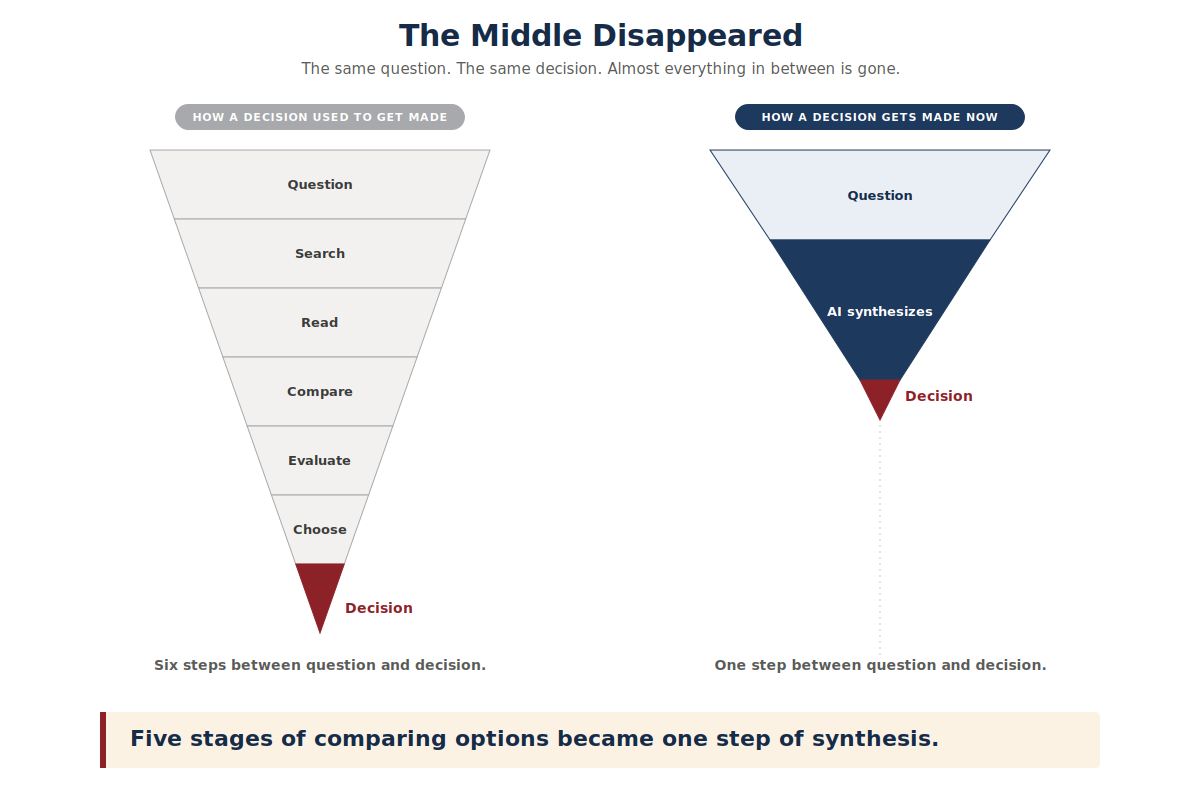
Notice what disappeared in the second version. No clicks. No blue links. No browsing five websites to compare. The AI does the browsing, and the homeowner just picks from what it hands them.
This is happening right now, not in some hypothetical future. And it's worth understanding, because the same shift that knocked the wind out of HubSpot is coming for every local service business that built its marketing around the old rules.
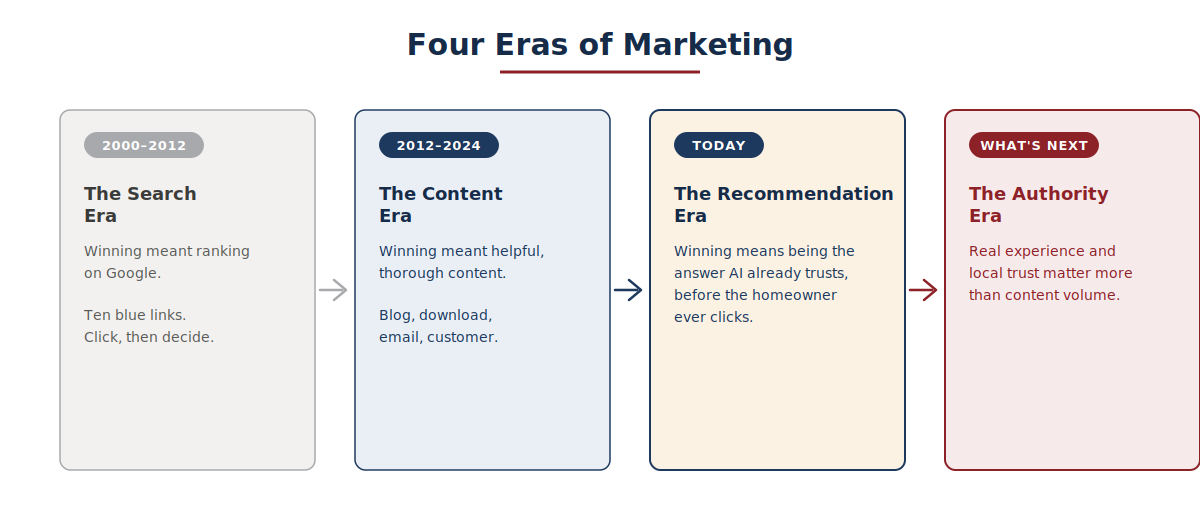
Four Eras, One Pattern
It helps to see the whole arc at once.
The Search Era (roughly 2000 to 2012). Google changed everything. Winning meant ranking. If you showed up on page one, you got the call. Simple as that.
The Content Era (roughly 2012 to 2024). Ranking wasn't enough anymore. Google started rewarding companies that answered questions thoroughly, not just companies that stuffed in keywords. This is the era HubSpot built its empire on: write the helpful blog post, offer the download, collect the email, nurture it in the CRM, land the customer. It was a genuinely great strategy. It just assumed a human would be doing the reading, clicking, and comparing.
The Recommendation Era (right now). AI tools increasingly do that reading, clicking, and comparing for the homeowner. The question isn't "who ranks number one" anymore. It's "who gets mentioned when someone asks an AI assistant for the best plumber in town."
What comes next. The companies that win the next decade won't necessarily be the ones with the most traffic. They'll be the ones AI trusts enough to recommend. That's a different game than the one most contractors are still playing.
Do You Notice What's Missing?
Go back and look at that second diagram again. Question, AI, recommendation, decision.
Clicks. Research. Ten blue links. All of it, gone.
A homeowner used to type "furnace repair near me," scroll through ten results, click into three or four websites, compare reviews, and eventually pick up the phone. That whole process took time, and every step of it was a chance for your website to make the sale.
Now, more and more, that homeowner just asks ChatGPT or Gemini which HVAC company they should call, and the AI hands back two or three names. The homeowner never sees your website. They never compare five companies side by side. They just call whoever the AI already vouched for.
You're not losing a click. You're losing the entire moment where your marketing used to do its job.
What This Actually Means for Contractors
Most contractors still think about marketing the same way they did five years ago: rank on Google, run some ads, keep the website looking sharp. Those things still matter. None of them stopped working. But they stopped being enough.
The goal used to be ranking. The new goal is being the company AI already trusts before the homeowner ever starts looking.
That's a real shift, and it changes what's worth spending time and money on.
The New Marketing Flywheel
The old flywheel was simple:
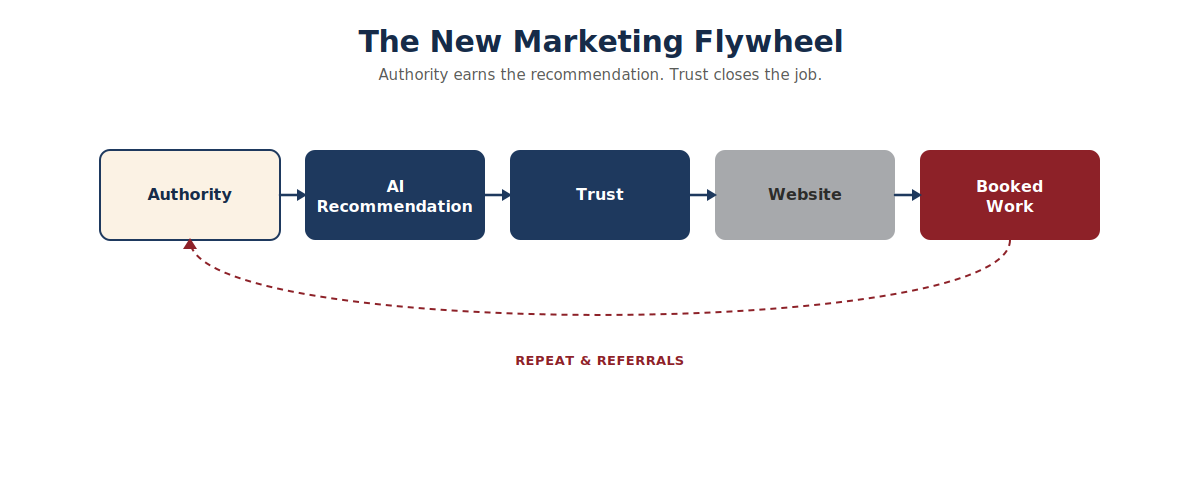
The new one has an extra step, and it's the step that matters most:
Before AI recommends you...
It has to trust you.
Before an AI will recommend your company, it needs a reason to trust that you're the real deal. Your website still matters. It's just no longer the first stop. It's the place someone lands after they've already decided you're worth calling.
What Authority Actually Means
This isn't a technical SEO trick. It's not something you buy. Authority is built the same way trust has always been built, it's just that AI is now paying attention to the same signals a smart homeowner already looks for.
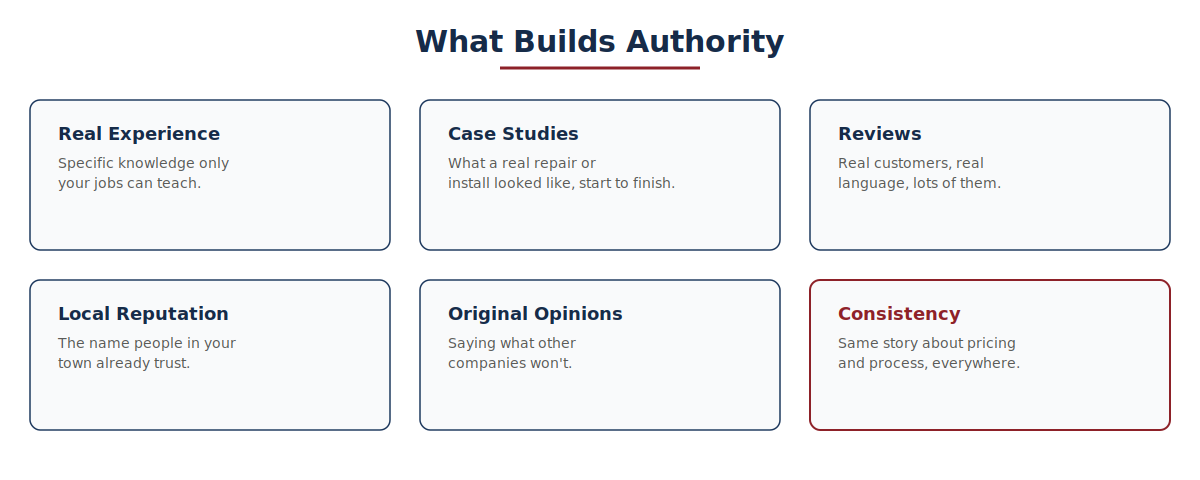
Authority comes from things like:
Real experience, not generic advice. A landscaping company writing about the specific drainage problems common to their region reads differently than a national blog with a stock photo and no local knowledge.
Actual case studies. A roofing company sharing what a real storm-damage claim looked like, start to finish, teaches an AI (and a homeowner) something a listicle never could.
Reviews, and lots of them, from real customers using real language.
Local reputation. Sponsoring the little league team, showing up at the county fair, being the guy everyone in town already knows by name. That reputation used to only spread by word of mouth. Now it also shows up in what AI tools can find and cite.
Original opinions. A plumber willing to say "here's what most companies won't tell you about tankless water heaters" stands out more than another rewritten "top 5 signs you need a repair" post.
Teaching, plainly and honestly, without trying to sell in every sentence.
Consistency. Saying the same thing about your pricing, your process, and your guarantees everywhere someone might look for it.
None of this is new advice. It's the same stuff that's always separated a trusted local company from a forgettable one. What's new is that AI systems are now reading all of it and deciding who to put in front of the customer first.
The HubSpot Lesson, Without the Panic
It's tempting to read the HubSpot story as a cautionary tale about a company that got it wrong. That's not really what happened. HubSpot optimized for traffic because, for a very long time, traffic was the correct strategy. They were arguably the best in the world at it.
The environment changed, not the strategy. Volume of content used to be the advantage. Now, authority is worth more than volume. A company with fifty pieces of real, trusted, specific content will out-rank and out-recommend a company with five hundred generic blog posts.
That's actually good news for the kind of business this newsletter is written for.
Why This Might Be the Best News Independent Contractors Have Gotten in a Decade
Here's the part that should get your attention.
For years, independent contractors have been at a disadvantage against national brands, franchise rollups, and private-equity-backed service companies. Those bigger operations could out-spend you on ads, out-produce you on content volume, and out-rank you just by throwing more resources at it.
AI recommendation doesn't reward volume the same way. It rewards experience. It rewards trust. It rewards a real reputation built over real years in a real community. It rewards the kind of original insight that only comes from actually doing the work, not from a content team churning out articles about a trade nobody on that team has ever practiced.
You've spent years earning the kind of trust that AI is now specifically designed to notice. A national franchise with a hundred locations and a marketing department can't fake decades of being the shop everyone in your county already calls first. That's not a content strategy. That's just true, and it's exactly what this new system is built to surface.
Where to Start
You don't need to overhaul everything overnight. A few honest places to begin:
Look at what you already have. Reviews, before-and-after photos, real customer stories, the stuff you've been sitting on because it felt too small to matter. It matters more now than it ever did.
Write like the expert you already are. Not a generic "signs you need a repair" post. Something only you could have written, based on jobs you've actually run.
Get specific about your town, your climate, your customers. AI recommendations lean heavily on specificity. Vague content doesn't get cited. Precise, local, experience-based content does.
Stop measuring success by traffic alone. A smaller number of visitors who already trust you, because an AI tool already vouched for you, is worth more than a big number of strangers who never call.
The Better Question
For nearly twenty years, marketing rewarded the companies that got found.
The next decade will reward the companies that get recommended.
That's a subtle difference. But it's a completely different strategy.
If you're still asking how to rank number one on Google, you may be solving yesterday's problem.
A better question is:
Why should an AI trust my company enough to recommend it before a homeowner ever visits my website?
That's not a question you answer with another blog post or another SEO agency.
You answer it by becoming the company your community already trusts. By sharing real experience. By teaching. By showing your work. By earning a reputation that exists long before someone starts searching.
The companies that win this next era won't necessarily publish the most.
They'll become the companies everyone, including AI, already knows to recommend.