
Two New Google Rules. One Clean Opportunity for Contractors Who Play It Straight.
Google updated its review policy. No big announcement. No warning email. No grace period.
And if you run a home service business with any kind of structured review program, there is a reasonable chance you are already in violation.
Two Bullets. Real Consequences.
Inside Google's Maps User Generated Content Policy, under Rating Manipulation, two new bullets appeared:
Merchants requesting that staff solicit a certain number of reviews
Merchants requesting that staff solicit reviews that include specific content, including content that identifies a staff member
Two sentences. Significant consequences.
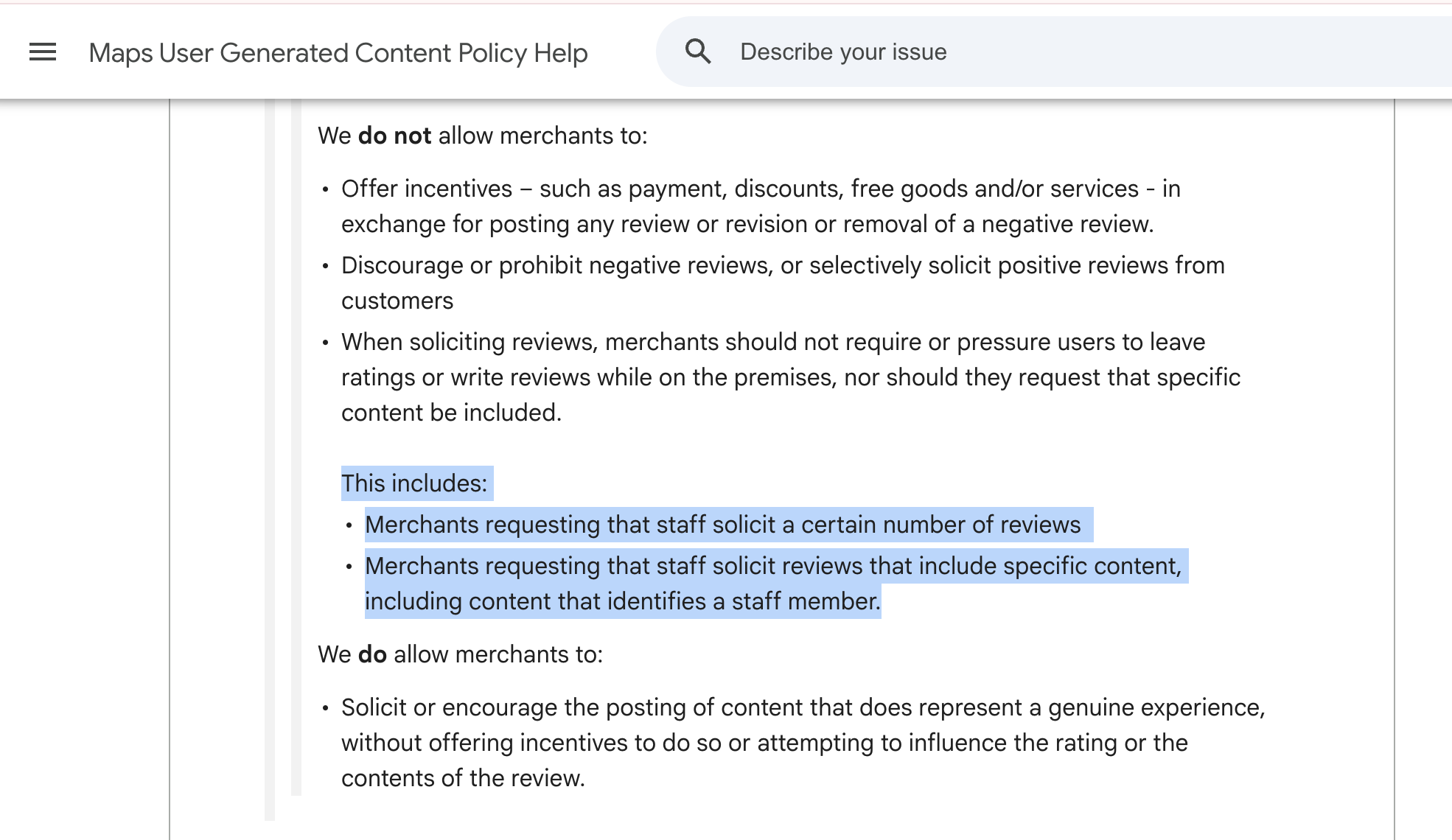
Google now explicitly prohibits review quotas and coaching customers on what to say—including asking them to name specific employees. Link to policy can be found here.
These Are Not Best Practices Anymore. They Are Policy Violations.
Review quotas for your techs = Violation.
Telling customers to mention the technician by name =Violation.
Scripts that ask for specific content in the review = Violation.
Monthly contests where the tech with the most five-star mentions wins a gift card = Violation.
This is not a gray area. Google spelled it out in plain language, and they added it to the same section that covers fake reviews and rating manipulation. They are telling you exactly how seriously they take it.
Local SEO expert Amy Toman caught the change first. Her read on it was blunt: "I expect they've seen too many review contests or requirements." And her warning was direct: "Be sure to update your staff on this. Don't want your reviews being filtered even more than they are currently."
Filtered. That word should get your attention.
What This Actually Looks Like in the Wild
You don't have to look hard to find it.
A quick scroll through Google reviews for any busy local business will show you exactly what Google is trying to stop.
Here is a real pattern we spotted recently at a local entertainment venue, details removed to protect the business, but the pattern is unmistakable:
Fourteen reviews posted within 48 hours. Multiple reviewers with the same last name. Several accounts with only one total review ever written, all posted the same weekend. Nearly identical language across unrelated reviewers. Staff members mentioned by name in review after review after review.
Ethan was AMAZING. Anna Marie was ABSOLUTELY AMAZING. Izzy was awesome. Brad was great.
You can almost see the staff contest behind it.
Here is the thing. That business probably thinks those reviews are helping them. And in the short term, maybe they are. The names are showing up. The stars are accumulating. The owner is responding cheerfully to every one.
But Google's algorithm is also watching. And what looks like momentum to the business owner looks like a pattern to Google.
Unusual volume. Coordinated timing. Coached language. Low-history accounts. Staff names repeated across unrelated reviewers.
Those are not signals of a thriving, beloved local business.
Those are flags.
And Google does not send a warning before it acts on them.
What Filtered Actually Means For Your Business
Google does not always remove a review outright.
Sometimes it just disappears. Not flagged. Not explained. Just gone. Quietly removed from your profile count while you wonder why your average dropped.
Other times the filter goes wider. Unusual patterns. Coached language. A spike in reviews that all sound suspiciously similar and mention the same technician by name. Google's algorithm notices. And when it does, it does not just pull one review. It pulls them all and starts looking at your entire profile.
For a contractor whose phone rings because of Google, this is not an abstract risk. This is your pipeline.
Here Is What You Can Still Do
Google is not telling you to stop asking for reviews.
They are telling you to stop manufacturing them.
You can ask. You can send a follow-up text with a direct link. You can train your team to deliver an experience worth five stars.
What you cannot do is put a number on it. Script the language. Or ask customers to mention specific people by name.
A genuine review of a genuine experience. That is the standard. It has always been the standard. Google is simply getting more aggressive about enforcing it.
Three Things To Do Before Friday
One. Pull your current review process and read it against the new policy. If you have quotas, scripts, or name-drop requests built into your follow-up sequence, remove them today. Not next week. Today.
Two. Tell your team what changed. Your techs and office staff need to understand what is at stake. A filtered review profile during peak season is not a minor inconvenience. It is lost revenue.
Three. Refocus on the work itself. The businesses that win on reviews long-term are not the ones with the best scripts. They are the ones that answer the phone, show up on time, and do the job right. That is what generates genuine five-star reviews at volume. That is exactly what Google is trying to protect. And it is the only review strategy that cannot be penalized.
The Bottom Line
Google is not punishing good businesses. It is clearing the field for them.
Every coached review, every name-drop script, every contest that manufactured five stars instead of earning them has been diluting the value of your genuine reputation for years. The contractors who did the work right, asked sincerely, and let the customer say whatever they wanted to say have been competing against a rigged system.
That system just got harder to run.
If your reviews reflect real experiences from real customers, this update is not a threat. It is an advantage. The playing field just got a little more level, and the businesses built on authentic reputation are about to feel it.
Do the work. Ask sincerely. Let the customer speak.
That has always been the strategy that lasts. Google’s recent move helps make it the only one that works.