
AI Receptionists for Contractors: Are They Actually Worth It?
Before you spend another dollar making the phone ring, figure out what happens when it does.
Contractors spend a lot of money generating inbound calls: Google Ads, Local Services Ads, SEO, direct mail, radio, sponsorships. Then they debate AI receptionists like it's a technology decision first. It isn't. The question that actually matters is simpler: how many good calls are going unanswered right now, and why?
If the honest answer is, "Basically none. Our CSRs pick up in two rings and book most of what's bookable," an AI receptionist may be a solution looking for a problem. If the honest answer is, "We don't actually know," or "Probably some, especially nights and weekends and when two people call at once," you've found something worth fixing.
AI is one way to fix it. It isn't automatically the right one.
What Is an AI Receptionist?
An AI receptionist is software that answers inbound business calls using a synthetic voice and AI instead of a person. Depending on the product and how it's configured, it can hold a conversation, ask qualifying questions, capture customer information, book or reschedule appointments, answer common questions, transfer calls, and send text confirmations.
Some products also integrate with field-service platforms, allowing information collected on the call to move directly into the systems a contractor already uses. The capabilities vary considerably, which is one reason I wouldn't start by shopping for vendors. Start by figuring out what you need the thing to do.
What Can One Missed Call Actually Cost a Contractor?
Here's one number worth paying attention to: in a 2025 analysis of 1.1 million business phone conversations across seven industries, CallRail found that home-service businesses had a 14% missed-call rate, third-highest among the industries studied.
On a shop fielding 300 calls a month, 14% is 42 calls nobody picked up.
Nobody can give you a reliable, universal dollar figure for what a missed call costs your business, and you should be skeptical of anyone who tries. What you can do is build the math using your own numbers.
Here's a hypothetical example using round numbers, not industry benchmarks:
$15,000/month in combined demand generation
250 inbound calls attributed to that activity, or roughly $60 per call
At a 14% miss rate, about 35 calls go unanswered
If one-third of those callers were legitimate, ready-to-book prospects, that's roughly 12 lost opportunities
At a hypothetical $350 average service ticket, that's $4,200 in immediate potential revenue
And that's the simple version. It doesn't account for the replacement or installation opportunity hiding inside a routine service call. It doesn't account for the marketing spend already sunk into producing the call. And it doesn't account for the future value of a customer who now has a relationship with whichever contractor answered instead.
Change any of those inputs and the number changes. That's the point. Run the calculation with your numbers. The exercise matters more than mine does.
Consider what this looks like in real life. It's 7:14 on a July evening and a homeowner's AC stops working. She searches Google and calls Contractor A.
Voicemail.
She calls Contractor B. Something answers, asks what's going on, confirms her ZIP code and gets her scheduled for the next morning.
Contractor A may have better technicians. Better reviews. A better website. They may have spent considerably more money earning that spot on Google.
None of it mattered. Contractor B answered.
What Can an AI Receptionist Actually Handle?
AI receptionists are particularly well suited to calls that are predictable, repetitive and relatively low stakes: after-hours lead capture, overflow when every CSR is already on the phone, basic scheduling and rescheduling, collecting names and addresses, answering questions about hours or service areas, and routing callers to the right person.
They're also remarkably good at one thing humans simply can't do: answering three or five or ten calls at the exact same moment. That matters when the first 90-degree day hits and everybody's AC seems to fail at once.
The limitations matter just as much. An angry customer, an unusual technical question, a sensitive billing dispute or a high-value replacement opportunity can require empathy, persuasion and judgment that you may not want to delegate. Current AI systems can also misunderstand callers, handle unexpected situations awkwardly, or frustrate someone who simply wants to speak with a person.
Good configuration matters enormously. An AI system that recognizes when it's out of its depth and quickly hands the call to a human can be useful. One that traps an angry customer in an increasingly ridiculous conversation can create a bigger problem than the one you were trying to solve.
When Should a Human Answer the Phone?
There isn't a perfect dividing line, but I think about it in terms of stakes and ambiguity. The more predictable and transactional the conversation, the stronger the case for AI. The more emotional, unusual, expensive or judgment-heavy it becomes, the more valuable a good human is.
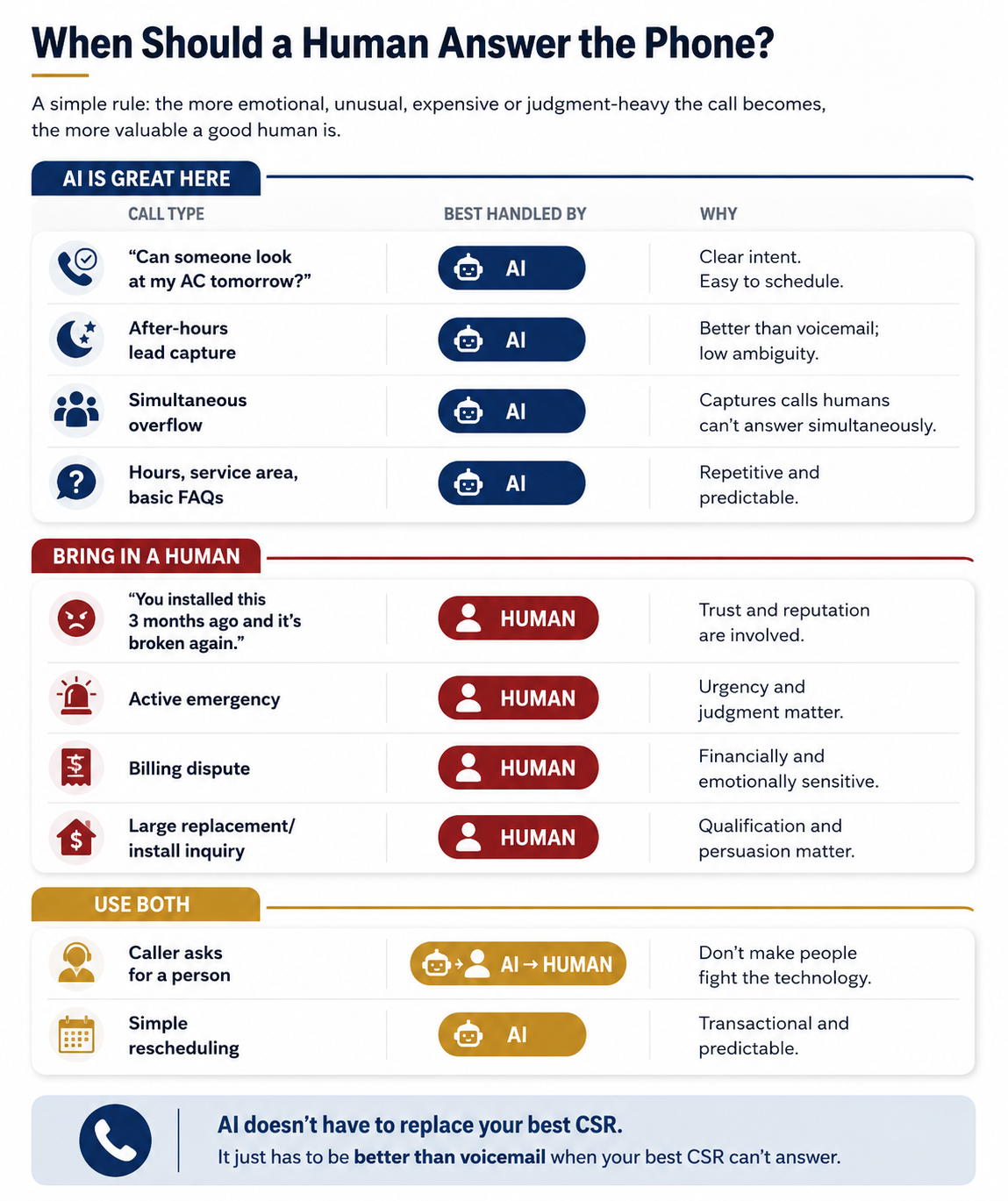
Guide showing which contractor phone calls are best handled by an AI receptionist versus a human CSR.
AI Receptionist vs. Human Answering Service vs. Another CSR
This is where I think contractors can get distracted by sticker prices.
AI receptionists can be inexpensive relative to hiring another full-time employee. Human answering services cost more but give callers access to actual people. Another CSR gives you far more control, context and flexibility, but also comes with the full cost and complexity of another employee.
Those aren't interchangeable products.
Instead of asking only, "What does this cost per month?", I'd want to know:
What does it cost per additional booked call?
A $100-a-month system that answers hundreds of calls but books nothing isn't cheap. A more expensive solution that consistently captures profitable jobs you were previously losing may be.
That's the number I'd use to evaluate almost any answering solution.
The Model That Works for Most Established Shops
For a shop that already has a good CSR or two, I wouldn't start with "replace them with AI." I'd start much narrower: make sure a revenue-producing call never reaches voicemail simply because every human is occupied.
That might mean humans answer first during normal business hours, while AI catches overflow and after-hours calls. Anything involving an angry customer, an emergency, an unusual situation or a caller explicitly requesting a person gets escalated according to a clearly defined process.
Put differently: the AI's job doesn't necessarily have to be replacing your receptionist. It can simply stand between a paid lead and a dead voicemail box.
That's a much easier business case to test.
Don't Skip Compliance
AI phone systems may record, transcribe and store customer conversations, and recording, consent and disclosure requirements can vary by jurisdiction and by how the technology is being used.
Before turning one on, understand exactly what your vendor records, how that information is stored and what notification or consent requirements apply where you operate. Don't assume the software company has made every compliance decision for your particular business.
This isn't the interesting part of buying an AI receptionist. It is, however, something you want to understand before deployment rather than after a complaint.
How to Test an AI Receptionist Before You Commit
Before you evaluate vendors, establish your baseline.
For two to four weeks, measure total inbound calls, unanswered calls, abandoned calls, after-hours volume, average hold time, booking rate, revenue booked by phone, and how quickly missed calls receive a callback. If possible, separate genuine customer opportunities from spam, vendors and other calls that weren't realistically bookable in the first place.
Then figure out exactly where the leak is.
A shop answering nearly every legitimate call quickly with a strong team may not need an AI receptionist at all. A shop discovering that a meaningful number of paid leads are reaching voicemail has a very different problem.
Only after you know that should you start shopping.
A 30-Day Pilot, Week by Week
Week 1: Measure your baseline. Don't change anything yet. You need to know what currently happens before you can claim a new tool improved it.
Week 2: Configure AI for one narrow use case. After-hours calls or overflow when every CSR is occupied are obvious places to start. Don't hand over your entire phone operation on day one.
Weeks 3–4: Compare performance against your baseline. Look at answer rate, booking rate, caller abandonment, successful transfers, appointments actually booked, customer complaints and situations the AI handled poorly. Most importantly, calculate the cost per additional booked call, not merely the cost per call answered.
At the end of 30 days, you should have enough information to make a reasonably informed decision. Expand it, adjust it or walk away. A pilot that captures profitable jobs that previously disappeared into voicemail has earned the right to expand. One that frustrates customers and produces no incremental bookings has told you something useful too.
So — Is It Worth It?
Often, yes—if you're comparing it with an unanswered phone.
That's the distinction I think gets lost in most conversations about AI receptionists.
A great CSR who knows your customers, understands your business, can calm someone down and recognizes a $15,000 replacement opportunity when she hears one is extraordinarily valuable. I wouldn't be looking for software to replace her simply because software exists.
But she's already talking to another customer. It's 8:30 at night. It's Sunday morning. Three phones ring simultaneously.
Now the comparison isn't:
AI vs. your best CSR.
It's:
AI vs. voicemail.
And that's a very different calculation.
The goal was never to have an AI receptionist. The goal is to make sure good opportunities don't disappear because nobody answered.
Sometimes the answer is AI. Sometimes it's another CSR. Sometimes it's a human answering service. Sometimes the process itself is broken and no phone system will fix it.
Find the leak first. Then choose the tool.
Frequently Asked Questions
Is an AI receptionist worth it for a small HVAC or plumbing company?
It depends on where your calls are currently falling through. If you're already answering nearly every legitimate call quickly, it may not be a priority. If good calls regularly hit voicemail—particularly after hours or when your staff is busy—it's worth testing an AI receptionist for a narrow use case and measuring whether it produces additional booked work.
Can an AI receptionist book real appointments?
Yes. Depending on the product and its integrations, current AI receptionist systems can collect customer information, check scheduling availability and book or reschedule appointments. Verify exactly what a vendor can do with your existing field-service software before buying.
Will customers know they're talking to AI?
That varies by system and how the business configures it. Regardless of the legal requirements that apply to your business, don't design a customer experience around tricking someone into believing software is a person. If a caller asks for a human, give them a reasonable path to one.
Does an AI receptionist replace a CSR?
It can automate some of the work traditionally performed by CSRs, but replacement doesn't have to be the goal. For many established contractors, the more compelling use case is catching overflow and after-hours opportunities while humans continue handling calls where judgment, empathy and persuasion matter.
How much does an AI receptionist cost for a contractor?
Pricing varies considerably based on call volume, minutes, features, integrations and whether the service uses AI only or combines AI with human agents. Rather than evaluating the investment solely by monthly subscription price, calculate what the system costs for each additional booked call it produces.
Indianapolis AI Receptionist Case Study:
Anonymous Local Auto & Tire Shop
Independent 5-bay repair shop
Owner: Dave
6 employees: Dave, 4 technicians, 1 service advisor
Open Monday–Friday, 7:30–5:30
Closed weekends
Rough numbers (shared with permission).
25 inbound calls/day
~500 calls/month
12% go unanswered: 60 missed calls/month
Average repair order: $500
One service advisor handles the counter and the phone
No dedicated receptionist
After-hours calls go straight to voicemail
They spend $4,000/month across Google Ads, local SEO, direct mail, etc.
A $500-ish repair order is quite plausible; NADA reports $494 per customer repair order for dealership service departments in 2025, while independent-shop industry reporting commonly puts repair orders in roughly the $400–$600+ range.
Let's Run the Numbers on our Auto Shop
Imagine a five-bay independent repair shop. Four technicians, one service advisor, and an owner who still spends plenty of time working in the business. They're busy. The bays stay full. They spend about $4,000 a month making sure people in their town know they exist.
The phone rings about 25 times a day.
Most calls get answered. But the service advisor is also checking customers in, explaining estimates, ordering parts and taking payments. Sometimes she's already on the phone when another call comes in. Sometimes everyone is standing at the counter at 8:00 Monday morning. And anything that comes in after 5:30 goes to voicemail.
Let's say Miller's gets 500 calls in a typical month and misses 12% of them. That's 60 calls.
Not 60 lost jobs. Some are spam. Some are vendors. Some are customers asking whether their car is ready. Some are price shoppers who were never going to book.
But some sound like this:
"Hi, my check-engine light came on this morning and now the car is shaking. Do you have anything available today?"
That person isn't particularly interested in leaving a voicemail and waiting to see whether Miller's calls back. They need their car fixed. So they call the next mechanic.
Now suppose only 15 of those 60 missed calls each month were legitimate new service opportunities. At a hypothetical $500 average repair order, that's $7,500 in potential monthly work reaching voicemail.
That doesn't mean an AI receptionist magically creates $7,500 in revenue. Some callers still won't book. Some jobs won't be worth $500. Some appointments will cancel.
But now Dave knows what problem he's evaluating.
He's no longer asking:
"Should I buy an AI receptionist?"
He's asking:
"Can I recover enough of those 15 opportunities to justify what it costs?"
That's a much better question.