
Honey Homes vs. Angi: The Real Story Is About Who Owns the Context
Search built the last twenty years of home services. Context may build the next twenty. Honey Homes and Angi are both, in their own way, betting on that shift.
Every few months, someone writes a version of the same article: Honey Homes vs. Angi, a scrappy handyman-membership startup squaring off against the incumbent lead-generation giant. It's a tidy narrative. It's also too small.
Honey Homes isn't interesting because of handyman memberships. Angi isn't interesting because of lead generation. They're interesting because both companies — a three-thousand-member startup and a publicly traded marketplace processing $35 billion a year — are converging on the same realization from opposite directions: whoever owns the context owns the recommendation.
That's the actual thesis. Not "these two companies solve different problems," though they do. The bigger claim underneath it: the next decade of home services will be won less by whoever helps homeowners search better, and more by whoever owns the trusted relationship before a search is ever necessary. Honey Homes is evidence that this works. Angi is now visibly rebuilding itself around the same bet. AI is the accelerant that makes it inevitable rather than optional.
Search is becoming optional. Context is becoming the moat. Everything in this piece is downstream of that one idea.
Key Takeaways
The next competitive advantage in home services isn't better discovery — it's owning context: the accumulated, specific knowledge of a home's systems, history, and trusted contractors that lets a company (or an AI) make a recommendation before the homeowner ever searches.
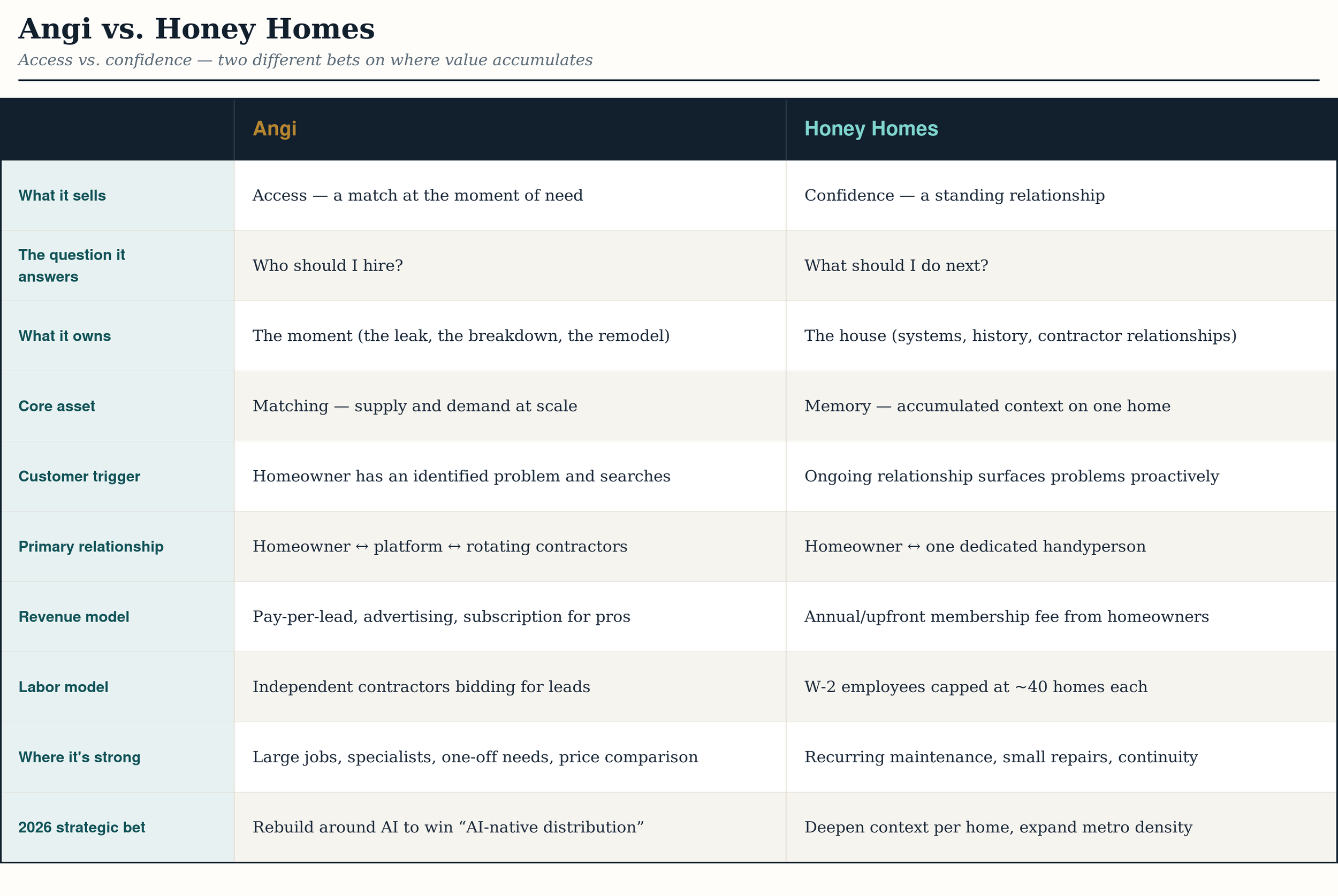
Angi sells access — matching a homeowner to a pro after something breaks. Honey Homes sells confidence — a standing relationship that tells the homeowner what needs attention before it breaks. One answers "who should I hire?" The other answers "what should I do next?"
Angi owns moments — the leak, the broken furnace, the remodel. Honey Homes is trying to own the house — every filter, every smoke detector, every contractor relationship, continuously. One is built around transactions. The other is built around stewardship.
Home services has moved through three eras, and the labels matter: Information (Yellow Pages, Angie's List — find someone trustworthy), Discovery (HomeAdvisor, Angi, Thumbtack — compare and match), and now Context (Honey Homes, AI-native assistants — recommendations replace searches entirely).
AI doesn't just accelerate this shift — it makes it close to inevitable. Large language models get more useful the more context they hold about a specific home. A system that already knows a water heater is nine years old has no reason to wait for the homeowner to type "water heater replacement near me." It has every reason to say something first.
Angi's own leadership is making this exact bet in public. In 2026, CEO Jeff Kip froze the company's legacy platform and redirected engineering toward an agentic tool he calls the Angi Pro Chief Revenue Officer, stating plainly that Angi intends to "win the AI-native distribution surface" because "LLMs recommend what delivers results."
For independent contractors, the practical implication isn't that SEO or Google reviews stop mattering — they don't. It's that being recommendable by a person, platform, or AI system that already holds context on you is becoming a second, parallel form of distribution alongside being discoverable in search.
Winning either form of distribution depends on the same unglamorous discipline: fast follow-up, honored appointments, clean records, no lead left to rot in an inbox. Call it plugging revenue leaks — the label matters less than the habit.
What Is Honey Homes?
Honey Homes, founded in 2021 by Vishwas and Avantika Prabhakara, is a membership-based home maintenance service. Instead of hiring a different contractor for every job, members are paired with a single, dedicated, W-2 handyperson — capped at roughly 40 homes per handyperson — who becomes the ongoing point of contact for repairs, preventive maintenance, and home improvement.
Membership isn't cheap, and it isn't meant to be. Pricing has run in the range of thousands of dollars a year for a fixed bank of service hours, with the current published model built around roughly 42 hours of flexible service over 12 months. Homeowners manage everything through an app: booking specific arrival times rather than four-hour windows, tracking a running to-do list, and messaging their handyperson directly. For jobs outside a generalist's scope — a licensed electrician, a roofer, a specialist — Honey Homes refers members to vetted partners rather than trying to do everything itself.
The company has raised just over $21 million across a Series A and Series A-1, backed by Khosla Ventures, Pear VC, and Era Ventures, with personal investment from DoorDash co-founder Tony Xu and Lyft co-founder Logan Green. As of 2026, Honey Homes reports more than 3,000 members across the Bay Area, Los Angeles, Dallas, Austin, and Chicago — expansion from roughly 1,000 members in three metros just two years earlier.
What Honey Homes is actually selling isn't hours of handyman labor. It's memory. A dedicated handyperson who has worked the same 40 homes for a year knows which water heaters are aging, which gutters clog fastest, which homeowner wants a text at 7 a.m. and which wants one at noon. That accumulated, specific knowledge is the product. The repairs are just how it gets delivered.
What Is Angi?
Angi is the product of two decades of consolidation in home-services lead generation. Angie's List launched in 1995 as a paid, review-driven directory — homeowners subscribed to read verified ratings of local contractors, an answer to the trust problem in a pre-smartphone world. HomeAdvisor, built on a different model of instant contractor matching, emerged as a rival. In 2017, IAC merged the two into ANGI Homeservices; by 2021, the combined company folded both brands into a single identity, Angi, after research found the Angie's List name carried more residual trust than HomeAdvisor's. In April 2025, Angi completed its spin-off from IAC and now trades as a fully independent public company under CEO Jeff Kip, with former IAC CEO Joey Levin serving as Executive Chairman.
The business model is fundamentally about matching supply and demand at the moment demand appears. A homeowner has a leaking faucet, searches, submits a request, and Angi routes that request — as a paid lead, an ad placement, or (increasingly) a "proprietary" service request generated on Angi's own properties — to contractors willing to pay for the introduction. In January 2025, Angi shifted a large share of its marketplace to a "homeowner choice" model, letting homeowners actively pick which pros can contact them rather than auto-distributing leads to whoever bid highest. Early results were mixed but instructive: homeowner satisfaction rose and contractor win rates on the leads they did receive improved substantially, while overall lead volume tightened as the funnel shifted toward quality over quantity.
By 2026, Angi's own numbers illustrate both the opportunity and the limits of a business built on moments rather than memory. In its Q1 2026 shareholder letter, CEO Jeff Kip disclosed that $35 billion in annualized homeowner job value now flows through Angi's platform each year — but only about $10 billion of it is actually completed by an Angi pro. Of every ten homeowners who submit a service request, seven complete the job and six hire someone; only two hire a pro found through Angi. That $25 billion gap between value flowing through the platform and value actually captured by it is, in Kip's words, the opportunity "to unlock on our platform today." It's also a precise illustration of what a moment-based business leaves on the table: Angi can get in front of the homeowner at the instant of need, but it has no memory of them the next time, and neither does the homeowner have any reason to come back to the same pro unprompted. Angi is targeting roughly 7% share of the $700 billion home services market — modest, Kip notes, next to the 15–20% share "leading internet marketplaces command" of their own addressable markets.
Access vs. Confidence: The Distinction That Actually Matters
"Discovery vs. continuity" is a fine way to describe these two companies. It's also too polite. Here's the sharper version.
Angi sells access. The relationship begins after something breaks. The question Angi answers is who should fix this? Its value is matching — connecting a homeowner, at the moment of need, to a stranger who happens to be available and qualified. That's a real and valuable service. It is also, by construction, a business with no memory. Every job starts the relationship from zero, because the platform's job is to be everywhere for everyone, not to know any single home intimately.
Honey Homes sells confidence. The relationship begins before anything breaks. The question it answers is what needs attention next? Its value isn't the repair — plenty of handymen can change a filter — it's the standing knowledge of the house that lets someone say so before the homeowner has to ask. Confidence isn't a feature Honey Homes bolts on top of maintenance. It is the product.
Put another way: Angi owns a moment. The leak, the broken furnace, the clogged drain, the remodel. Honey Homes wants to own the house — every filter, every smoke detector, every loose railing, every maintenance reminder, every contractor relationship, indefinitely. One company is optimized to capture transactions at scale. The other is optimized to compound trust in a single relationship over years. Those are not two flavors of the same business. They are two different bets about where the economic value in home services actually accumulates — in the next click, or in the next decade of a single home's history.
Neither bet is free. Confidence is expensive to build — it requires dedicated labor, tight geographic density, and a customer willing to pay upfront for peace of mind rather than per repair. Access is expensive in a different way — it requires enormous, continuous marketing spend to be present at the instant intent appears, because trust has to be rebuilt from scratch in every single transaction. That's why Honey Homes can run a real business at 3,000 members while Angi needs to processes billions of dollars of job value just to convert a fraction of it. Scale looks different when the asset you're compounding is trust instead of traffic.
Three Eras: From Information to Discovery to Context
The Honey Homes/Angi split makes more sense as the latest chapter in a longer story about what homeowners have had to do to get help — and the story isn't really about how they found someone. It's about how much a homeowner had to know, ask, or search before help arrived, and who held the information that closed that gap.
The Information Era
For most of the 20th century and into the 2000s, the problem was pure information asymmetry. You needed a plumber, you didn't know one, and the Yellow Pages gave you a wall of names with no way to tell the competent ones from the con artists. Angie's List, launched in 1995, was a direct response: a paid membership product built entirely around solving the trust problem through verified reviews. The scarce resource in this era was simply information — who's out there, and are they any good. The value proposition was find someone trustworthy, and it was valuable enough that people paid a subscription just to access the list.
The Discovery Era
The smartphone and the on-demand economy changed the unit of value from information to instant matching. HomeAdvisor, Thumbtack, and eventually the merged Angi entity, along with Google Local Services Ads, turned the directory into a two-sided marketplace: homeowners describe a job, algorithms match them to available, verified pros, and the platform gets paid for the introduction rather than for access to a list. The scarce resource became attention at the moment of intent — showing up first when someone searched. This era built the multi-billion-dollar lead-generation industry that still dominates the category today, but it also introduced a structural tension contractors know well: the platform's incentive is to maximize the number of leads sold, not necessarily the number of jobs won by any single pro.
The Context Era
What's emerging now — and Honey Homes is the clearest early example, though not the only one — treats the contractor relationship less like a transaction and more like ongoing stewardship of a physical asset. The scarce resource shifts again, this time to context: the accumulated, specific knowledge of a home's systems, maintenance history, equipment age, and trusted contractors that lets someone act before being asked. The homeowner doesn't compare bids; they have a standing relationship, human or increasingly AI-assisted, that already knows the house and tells them what to do next. Recommendations replace searches. This is a smaller, younger, less proven category than the discovery era — Honey Homes has 3,000 members, not millions — but it's the direction both the venture-backed upstarts and the public incumbent are now racing toward.
It's worth being honest about where the Context Era actually stands: it's early, it's expensive to deliver, and it hasn't been proven at anything like marketplace scale. It probably won't fully replace the discovery era, especially for large, infrequent jobs like roofs or additions, where some comparison shopping will likely always make sense. The interesting question isn't whether context replaces discovery outright — it's how much of the large, recurring, predictable middle of home maintenance migrates toward whoever holds the most context, and how much stays a matching problem.
Why AI Makes This Shift Inevitable, Not Just Faster
Here is the idea that ties the whole piece together, and it has less to do with either company specifically than with a basic property of large language models: they become dramatically more useful the more context they hold. This isn't a minor accelerant on top of an existing trend. It's the reason the Context Era stops being a niche, venture-backed bet and starts being the obvious design for anyone building home services from scratch.
A general-purpose AI assistant with no memory of your home is not meaningfully different from a search engine. Ask it "why is my water heater making noise," and it gives you a generic diagnostic tree, same as the top result on Google. That's a discovery interaction wearing a chat interface — a new coat of paint on the same old moment.
Now imagine ChatGPT, or whatever assistant a homeowner actually uses, holding real context: every appliance, every past repair, every contractor who's ever worked the property, every receipt, every warranty, every maintenance schedule. That assistant doesn't wait for a diagnostic question. It already knows the water heater is a 2017 install, that the home is on well water with known sediment issues, that a similar unit failed at a comparable property on the same system two years ago, and that the homeowner's preferred plumber already has an open ticket on this exact address. Why would it ever tell the homeowner to search? It has no reason to. It already knows.
Honey Homes is, in effect, building that context layer manually today, one dedicated handyperson and one home at a time. AI doesn't replace that model — it makes the underlying asset exponentially more valuable tomorrow, because the same accumulated context that makes a Honey Homes handyperson useful is exactly what makes an AI assistant useful, at a fraction of the marginal cost once it's captured in software rather than in one person's head.
Angi's own leadership has reached the identical conclusion, from the opposite side of the business. In its May 2026 shareholder letter, CEO Jeff Kip announced Angi would feature-freeze its legacy platform, stop issuing quarterly guidance, and redirect its entire product and engineering organization toward what he called an "AI-native future." The centerpiece is a product Kip named the Angi Pro Chief Revenue Officer — an agentic system meant to do more than hand a contractor a lead. It's designed to capture job details, send automated responses, book appointments, generate quotes, and handle the "consistent follow-up" that most small contractors don't have the staff to do well. The first version, Kip wrote, will be an "AI front desk" for pros — an agent that makes and receives calls to book appointments on a contractor's behalf.
Kip's letter is the clearest public articulation yet, from inside a company built on discovery, of why context is becoming the strategic prize. "LLMs recommend what delivers results," he wrote. "When our pros win jobs and do them well, that consistent outcome earns durable platform preference the same way results earned us preference on web search." He drew the historical line explicitly: "Just as HomeAdvisor and Angie's List once won organic search, and Angi is now winning paid search and social, we intend to win the AI-native distribution surface. Our goal is to be the destination not just for homeowners but also for personal AI agents acting on their behalf." Angi says it is already live inside ChatGPT's app ecosystem and buying traffic through OpenAI's ads product — an early, concrete example of a home-services company building for an audience of AI agents, not just human searchers.
That is, in effect, the largest player in the discovery era trying to grow context and memory into a business built on the opposite premise — that every job starts from zero. It's a tell. If the incumbent built for access is racing to build context and agentic follow-through into its own platform, and is explicitly framing the fight as one for "AI-native distribution" rather than search rankings, that confirms where the value is migrating, regardless of who gets there first or how well the retrofit works.
The mechanism is straightforward: an AI system's usefulness is bounded by what it knows. A homeowner with a system that has accumulated years of maintenance history, contractor performance, and equipment age has less and less reason to open a search bar at all. The assistant becomes the front door. Whoever owns that context — the AI layer, the membership provider, the smart-home platform, or some combination — owns a meaningfully stronger position than whoever wins the next paid click.
This doesn't mean marketplaces disappear. Big, infrequent, specialized jobs — a roof replacement, a kitchen remodel, an emergency after a storm — will likely always involve some comparison shopping, because the stakes are high enough and the frequency low enough that no single relationship can reasonably anticipate every need. But the large, boring, recurring middle of home maintenance — filter changes, caulking, minor repairs, seasonal upkeep — is exactly the terrain where memory beats search, and that terrain is bigger than it looks on a P&L.
What This Means for Contractors
None of this makes SEO, Google Business Profile optimization, or review counts obsolete. They remain the primary way most independent contractors get found today, and that will stay true for years, particularly for the large or emergency jobs where homeowners still compare options. Anyone telling contractors to abandon their marketplace presence or their search visibility is getting ahead of the data.
But the strategic question worth sitting with is this: discoverability got you found once. What makes you recommendable — chosen again, referred, or surfaced by an AI system that already holds context confirming you're reliable — is a different asset, and it's the one that compounds.
Recommendability is built the unglamorous way: showing up on time, communicating clearly, following up without being chased, honoring quotes, and handling the handful of small things that quietly determine whether a homeowner calls you again or starts a new search next time. It's also, increasingly, a data asset. A contractor with clean records of what they did, when, and how the customer responded is exactly the kind of contractor an AI-native platform — Angi's version or anyone else's — will learn to trust and surface more often. A contractor whose lead-response process is a missed call and a voicemail is training the system to route around them, because it has no context to recommend them on.
This is where the idea of a revenue leak becomes useful, not as a sales pitch but as an honest diagnostic. Plenty of contractors have strong search visibility and steady traffic and still leave money on the table, because the infrastructure behind the click — call routing, follow-up cadence, quote turnaround, CRM hygiene — has gaps. Industry reviews of contractor websites and lead-response practices consistently find the same pattern: solid inbound interest, and a meaningful share of it going unanswered or unconverted because of friction after the click rather than a lack of demand before it. The gap between a 4% and an 8% conversion rate on the same traffic effectively doubles the value of every dollar already spent on discovery — before a single AI agent enters the picture, and before context has any chance to compound in a contractor's favor.
That framework applies regardless of where a lead originates — Angi, Google, a referral, or eventually an AI assistant recommending a pro by name. The businesses best positioned for whatever the next decade brings are the ones that treat operational follow-through as seriously as they treat marketing spend, because that follow-through is exactly what turns a single transaction into the kind of context that gets a contractor recommended without being searched for again.
Frequently Asked Questions
Is Honey Homes a competitor to Angi? Not directly. Angi is a lead-generation marketplace connecting homeowners to independent contractors for individual jobs; Honey Homes is a membership service providing a dedicated, ongoing handyperson relationship. They serve different moments in the homeowner's need for help, and in practice a Honey Homes member may still use Angi or a similar marketplace for specialized or large-scale work outside their handyperson's scope.
What does a Honey Homes membership cost? Honey Homes operates on an annual or upfront membership fee that bundles a set bank of service hours (roughly 42 hours over 12 months in its current published model) with a dedicated handyperson and app-based scheduling. Pricing and structure have evolved as the company has scaled, so homeowners should confirm current terms directly with the company.
Is Angi still worth it for contractors in 2026? It depends heavily on the trade, the market, and how a contractor manages the leads they receive. Angi's shift to a "homeowner choice" model in 2025 reduced overall lead volume for many pros but improved win rates on the leads that came through, since homeowners were actively selecting who could contact them rather than being auto-matched. Contractors who pair Angi leads with fast, disciplined follow-up tend to fare better than those treating it as a passive spend.
What are the best Angi alternatives? Depending on the goal, alternatives range from other marketplaces (Thumbtack, Google Local Services Ads, Porch) to membership-based continuity models (Honey Homes and similar handyman-subscription services) to simply investing directly in owned channels — a contractor's own website, review profile, and referral network — rather than renting distribution from any single platform.
Why does AI matter for home maintenance specifically? Home maintenance is a domain built on accumulated, specific context: the age of a home's systems, its repair history, and which contractors have already done reliable work there. AI assistants become far more useful once they hold that context and can act on it proactively, which is why both AI-native startups and incumbents like Angi are investing heavily in building memory and context into their platforms rather than treating every homeowner interaction as a fresh search.
Will AI replace home services marketplaces? Unlikely to replace them entirely, but likely to change what they're for. Marketplaces will probably remain the default for large, infrequent, high-stakes jobs where comparison shopping makes sense. The recurring, predictable slice of home maintenance is the terrain most likely to shift toward context-based, AI-assisted models where the homeowner rarely needs to search at all.
What is the "Context Era" of home services? It's the phase, following the Information Era (directories like the Yellow Pages and Angie's List) and the Discovery Era (marketplaces like HomeAdvisor, Angi, and Thumbtack), in which the scarce resource shifts from information and matching to accumulated, specific context about an individual home — its systems, history, and trusted contractors — that lets a company or AI assistant recommend action before the homeowner searches at all.
More Information
For twenty years, home services companies competed to become the answer. The next twenty years may belong to whoever asks the question first: your water heater is nearing the end of its life; it's time to clean your gutters; your furnace should be serviced before winter arrives. That's a very different future than waiting for someone to type "plumber near me." Search built the last generation of home services. Context may build the next one.
Elizabeth Northern is the founder of Raise the Trades, where she helps independent home-service companies build marketing, AI, and business systems that turn local trust into booked work. After more than 15 years working alongside contractors, she writes about the future of home services, AI, and how changing technology is reshaping the way homeowners find—and trust—the people who work on their homes.
Sources and further reading: Honey Homes, Honey Homes — Building the Next Chapter, TechCrunch on Honey Homes' Series A-1, Angi Inc. Q1 2026 Shareholder Letter — Jeff Kip, Angi Q1 2026 Earnings Release (SEC), IAC Completes Spin-Off of Angi, Angi's Economy of Everything Home Research.