
What Roto-Rooter's Earnings Calls Reveal About the Real Cost of a Plumbing Lead
In October 2024, Roto-Rooter showed up in Google's local Maps results, nationwide, about 72% of the time. Within a few months, that number had fallen to 24%. It has since recovered to roughly 35%, still less than half of where it started.
Most contractors never get to see a number like that about a competitor, let alone about the industry's largest brand. Roto-Rooter is the exception, because it isn't really an independent company. It's a subsidiary of Chemed Corporation (NYSE: CHE), a publicly traded company that also owns the hospice provider VITAS Healthcare. Chemed reports quarterly earnings and holds a conference call four times a year, and on those calls, CEO Kevin McNamara and CFO Mike Witzeman have spent two years describing, in specific dollar figures, what has happened to Roto-Rooter's leads.
That's rare. Marketing agencies and franchise operators debate the "state of paid search" for home services in generalities: CPCs are up, organic is dying, private equity is ruining everything. Roto-Rooter's owners have to say what's actually happening, on the record, to analysts who ask pointed follow-up questions, every three months.
I spent nearly a decade inside the home services and local-search world at Angie's List, and watched my own family build and sell an HVAC company. I've sat through a lot of contractor lead-buying conversations. I've never seen the mechanics laid out this clearly before. So I read every Chemed earnings release and call transcript from the second quarter of 2024 through the second quarter of 2026, roughly two years, and pulled out everything the company said about leads, paid search, natural search, and the competitors driving the change.
Here's what it shows, and why it should matter to every independent HVAC, plumbing, electrical, and roofing company that never got invited onto the call.
Roto-Rooter Used to Get Most of Its Leads for Free
For most of Roto-Rooter's history as an internet-marketed business, the majority of its leads cost nothing per click. Homeowners searched "plumber near me," found Roto-Rooter in the organic results or the Google Maps pack, and called. On the fourth-quarter 2025 call, McNamara put a number on how dominant that used to be: "We used to get in excess of 55% of our leads on the natural search... That has totally flipped." By early 2026, natural search made up just over 40% of leads, and paid search covered the rest.
That flip is the whole story. Roto-Rooter didn't stop being findable. Google stopped showing it for free as often as it used to, and Roto-Rooter had to start paying to stand in the spot it used to occupy for nothing.
What Happened to Roto-Rooter's Google Leads?
The shift shows up gradually, then all at once, across two years of earnings calls.
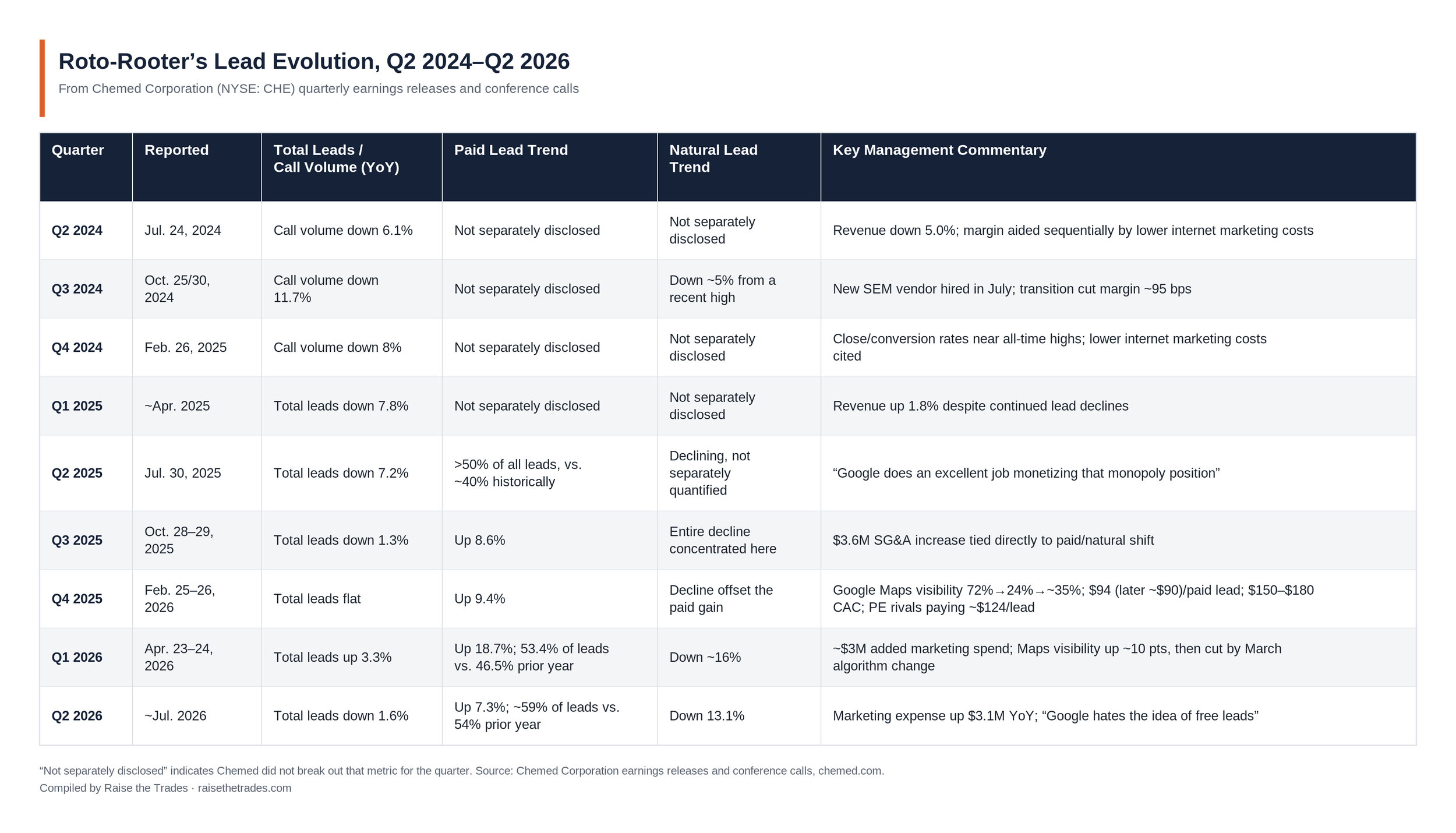
Table showing Roto-Rooter's paid vs. organic lead trends by quarter, Q2 2024 to Q2 2026, based on Chemed Corporation earnings calls
Two things stand out. Total leads bottom out around the first quarter of 2025 and slowly recover, but the mix underneath keeps tilting toward paid, quarter after quarter, even once total volume stabilizes. And every time paid leads climb, SG&A climbs with it. Every time natural leads decline, McNamara describes it as something Roto-Rooter didn't do, and couldn't stop. "Nothing Roto-Rooter could do," he said flatly on the Q1 2026 call, about a 16% drop in natural leads that quarter.
How Much Is Roto-Rooter Paying for Leads?
On the fourth-quarter 2025 call, McNamara gave about as plain an answer to this question as a public company will ever give: "We're paying $94 a lead compared to previously zero on a lot of those leads." Later in the same call, during Q&A, he rounded it to "roughly $90 per lead," and said the number hadn't moved much over the prior few quarters. It takes 1.5 to 2 leads to convert into a paying job, which puts Roto-Rooter's acquisition cost for a paid-search customer at roughly $150 to $180. By the fourth quarter of 2025, 60% to 65% of all leads were paid. By the second quarter of 2026, that had settled around 59%, up from 54% a year earlier and about 44% eighteen months before that.
The margin math here isn't complicated, even if it sounds like a finance lesson. A lead that used to cost the company nothing now costs somewhere around $90 to $94. Multiply that by the volume of leads Roto-Rooter has to buy in a given quarter, and you get the swings in marketing spend the company has reported: $3.6 million in the third quarter of 2025, roughly $3 million in the first quarter of 2026, $3.1 million more in the second quarter of 2026. Add those three quarters alone and it's close to $10 million in incremental spend, just to hold lead volume roughly where it already was. None of that money bought growth. It bought standing still.
Why Private Equity Changed Plumbing Lead Economics
Google's algorithm is one half of this story. The other half is who Roto-Rooter is bidding against.
McNamara has been consistent about naming the second cause: private-equity-backed consolidators moving into plumbing and drain cleaning, mostly as a feeder for their real business, HVAC. "They're basically HVAC companies that said, 'We're very happy with paying $124 per lead,' for a job that they'll say they'll clean any drain for $90," he said on the Q4 2025 call. "And the reason they're happy doing that is because... that becomes a long-term customer for their HVAC services."
That's the mechanism worth sitting with. A plumbing-only company has to make its economics work on the plumbing job itself. A PE-backed platform with HVAC economics behind it can treat the drain-cleaning call as a loss leader, because the homeowner relationship, the eventual furnace replacement, the maintenance plan, years of future service calls, is worth more than the first visit. That changes what a rational bid looks like in a paid-search auction. A company that has to profit on the first job can't out-bid a company that's happy to lose money on it.
The pressure has eased somewhat. "I consider the threat of private equity largely diminished at this point," McNamara said on the same call, noting Roto-Rooter's cost per lead had held roughly steady for three straight quarters instead of continuing to climb. Some of the branch managers Roto-Rooter lost to PE-backed competitors in 2022 and 2023 have reportedly come back, having discovered, in his words, that "trees don't grow to heaven."
What Roto-Rooter's Google Maps Decline Tells Contractors
The Google Maps figure is the clearest single data point in this whole arc, because it isn't a management estimate. It's something Roto-Rooter tracks directly: the share of relevant searches nationwide where its branches appear in the map pack. 72% in October 2024. A low of 24% within a few months. Recovery to roughly 35% by the end of 2025, helped by a new SEO vendor Roto-Rooter hired in December 2025, one management specifically noted "does not provide services to any of our private equity competitors."
Lay the timeline out in order and it tracks almost exactly with the paid-lead growth: as free visibility collapsed, paid leads had to rise just to keep total volume from falling off a cliff. By McNamara's account, Google's changes weren't neutral. "It's pretty darn clear to surmise that at this point, Google hates the idea of free leads," he said on the Q2 2026 call, a comment blunt enough that most public-company CEOs wouldn't make it out loud about their single most important distribution partner.
Is SEO Still Worth It for Plumbers?
Given everything above, it would be easy to draw the wrong conclusion: that organic search doesn't matter anymore, so why keep investing in it. Roto-Rooter's own numbers argue the opposite.
The reason its margins compressed wasn't that organic search became worthless. It's that losing organic visibility forced the company to go buy the same volume of leads it used to get for free. Every point of Google Maps visibility Roto-Rooter has clawed back, from 24% up to 35%, has translated directly into leads it didn't have to pay for. SEO didn't stop working. It became the thing standing between Roto-Rooter and paying $90-plus for every customer interaction it gets.
The mistake would be treating organic search as the only source of free demand, which is close to what Roto-Rooter actually did for the better part of fifteen years. A single-channel demand engine, even one built on a channel as dominant as "show up first on Google," is fragile in exactly the way this two-year stretch demonstrates. Google redrew the line between what it shows for free and what it charges for, and there was no vote for the businesses that line ran through.
Where AI Search Fits In
It's worth naming, briefly, what's happening one layer above Google Maps and paid search: homeowners are gaining more places to ask "who should I hire," and fewer of those places hand back a plain list of ten blue links.
This data is newer and less settled than Roto-Rooter's quarterly numbers, so it deserves more hedging. A 2026 BrightLocal survey put the share of consumers using AI tools to find local services at 45%, up from roughly 6% a year prior. Whitespark's research has found Google's AI Overviews now appear on a majority of local searches. None of that means traditional Google search is going away, and none of it means ChatGPT is about to become the primary way homeowners find a plumber. But it does mean the number of layers sitting between homeowner intent and contractor selection is growing, not shrinking, and every one of those layers draws on the same underlying inputs: reputation, structured information about the business, and a body of content and reviews substantial enough for an algorithm, or an AI model, to trust and cite.
That's the throughline connecting Roto-Rooter's Google Maps problem to whatever comes next. Whoever owns the layer between intent and selection effectively sets the price of being found. Right now, that's mostly Google. It may not always be only Google. Either way, the businesses caught flat-footed will be the ones that built their entire demand engine around one gatekeeper's current rules.
What Independent Contractors Should Do About It
A local HVAC, plumbing, electrical, or roofing company isn't going to outbid a multibillion-dollar, PE-backed platform in a paid-search auction, and pretending otherwise is a losing strategy. But Roto-Rooter's experience points to what an independent contractor can build that a bidding war can't take away.
An existing base of past customers who get called before they ever open Google. A membership or service-agreement program that manufactures repeat revenue instead of hoping a homeowner searches again. A referral system that turns satisfied customers into new leads at close to zero acquisition cost. A Google Business Profile and review velocity strong enough to hold organic position even as the algorithm shifts underneath it. Fast, consistent phone handling and same-day estimates, since Roto-Rooter's own numbers show close rates and response speed matter as much as lead volume. And a body of genuinely useful local content, the kind that gives both Google and AI systems something specific to point to when a homeowner, or an AI assistant reading on her behalf, asks who's actually good at this work.
None of that replaces paid search. It reduces how dependent the business is on it, which is the lesson sitting inside two years of Chemed earnings calls. Roto-Rooter's problem was never that it used Google. It's that for a long stretch, Google was close to the whole plan.
Google Should Be a Channel, Not Your Business Model
Strip away the ticker symbol and the SG&A line items, and Roto-Rooter's story is a straightforward one: a business that built its growth on a channel it didn't own, watched that channel change the terms without warning, and spent two years and tens of millions of dollars rebuilding demand it used to get for nothing.
That's not a reason to abandon Google. It's a reason to make sure Google is one input into how your business gets found, not the whole system. The contractors who come out ahead over the next few years won't be the ones spending the most on paid leads. They'll be the ones who never let a single platform, algorithm, or bidding war decide whether the phone rings.
Primary sources (Chemed Corporation investor relations and SEC filings):
Chemed Reports Second-Quarter 2024 Results, chemed.com, July 24, 2024
Chemed Corporation Q2 2024 earnings call, July 25, 2024 (via Investing.com earnings-call summary)
Chemed Corporation (NYSE:CHE) Q3 2024 Earnings Call Transcript, October 30, 2024 (Insider Monkey, transcript of the Chemed conference call)
Chemed Reports Fourth-Quarter 2024 Results, chemed.com, February 26, 2025
Chemed Corporation (NYSE:CHE) Q1 2025 Earnings Call Transcript, ~April 2025 (Insider Monkey)
Chemed Corporation (NYSE:CHE) Q2 2025 Earnings Call Transcript, July 30, 2025 (Insider Monkey)
Chemed Reports Third-Quarter 2025 Results / Q3 2025 Earnings Call Transcript, October 28–29, 2025 (chemed.com; Insider Monkey)
Chemed Reports Fourth-Quarter 2025 Results / Q4 2025 Earnings Call Transcript, February 25–26, 2026 (chemed.com; Insider Monkey)
Chemed Corporation (NYSE:CHE) Q1 2026 Earnings Call Transcript, April 24, 2026 (Insider Monkey)
Chemed Reports Second-Quarter 2026 Results / Q2 2026 earnings call, late July 2026 (chemed.com; Yahoo Finance earnings-call summary)
Secondary trade coverage used to corroborate management commentary:
Homepros, "Roto-Rooter residential revenue dips; CEO points to Google, private equity," March 2, 2026
Homepros, "Roto-Rooter residential revenue edges up — but lead costs bite," August 3, 2026
Contractor Magazine, "How AI Search is Changing How Homeowners Find Contractors," May 20, 2026 (cites BrightLocal 2026 Local Consumer Review Survey and Whitespark Q2 2025 research)
Methodology notes:
Every figure in the article and table is attributed to a specific Chemed earnings release or a direct quote/paraphrase from a named executive on a specific quarterly call.
Where a metric was not broken out publicly for a given quarter (for example, the paid/natural split before mid-2025), the table lists it as "not disclosed" rather than estimating it.
Two slightly different per-lead cost figures appear in the same Q4 2025 call ($94 in prepared remarks, "roughly $90" in Q&A); both are reported, since that inconsistency is itself informative about how loosely management rounds these numbers quarter to quarter.
Figures for Q2 2024 call volume (down 6.1%) come from a contemporaneous summary of the earnings call rather than a verbatim transcript, since a full transcript for that specific call could not be independently located; the underlying revenue and margin figures for that quarter were verified directly against Chemed's published earnings release.